my blog
My husband and I went to Saarbrucken, Germany; he went for a conference, I went for touristing and shopping. Both were excellent. He said the conference was fun, an adjective he's never before used to describe an academic conference, and I liked the town and Villeroy & Boch, who have a factory outlet nearby.
We took the ferry to Dunkirque and drove to Saarbrucken, on the border with France. The ferry was surprisingly empty - this the height of the tourist season. The hotel had a number of empty rooms. Saarbrucken was steel and iron and coal, high industry; now all bought from abroad, cheaper. It's trying to reposition itself as a tourist destination. The "state" of Saar is 63% forest, hilly and the part that's not trees is full of grazing sheep and cattle. I don't know how good it would be for winter trips, but in the summer there's hiking and walking and sitting around eating ice cream. I like the local cuisine - good beer, lager, sausages and potatoes in addition to excellent ice cream. The French influence adds pastries and breads. There's a good university and a couple of Max Planck research institutes.
It's Germany, and things are done well. The signs on the motorway, for example, are clear and easy to follow without speaking German. The motorway signs are the best I've ever seen. (Belgian ones, in contrast, are the worst. They are confusing and they lie. See a sign saying petrol is available; gratefully exit, with the car fuel gage quivering just above empty, and discover that there used to be a petrol station but it closed a long time ago.)
Things well-done: the windows in our room impressed me and I've tried several times in emails to describe them. The room wasn't air conditioned - and it was 95 degrees. But it was comfortable. It was a huge room, with with windows on two walls, allowing cross ventelation plus a door that opened onto a balcony. The windows were almost the width and depth of the room; six wood framed windows, and three opened. There were three settings. I could open the window from the top, open it full to the side or lock it. It was a very clever, well engineered design for a world without air conditioning.
I speak a little German, the result of two years German classes at university over forty years ago. I can ask basic questions, especially if I have time to rehearse them in my mind, but have great trouble in understanding the answers. Someone with the same basic skills in English that I have in German can have satisfactory linguistic interactions; that plus pantomime leaves us both feeling like fine skilled second language users. But my German is essentially useful for the subtext: i.e., I'm a poor witless foreigner in your country and I know I should use your language and I'm very sorry I can't. But Germans (and, really, just about everybody else) are patient. This came in very handy in Saarbrucken.
They did not speak English in the hotel. An elderly man had about as much English as I had German, but we got on fine. When we first came, it was the middle of the night. We followed the signs and GPS. There was forest. (There is forest most places in Saarbrucken.) The GPS told us we were there. We saw nothing but trees. We pulled over and my husband handed me the cell phone. I, after all, was the "German speaker".
In a mixture of German and English, I talked to the old man. He kept saying it was midnight and the doors closed at midnight. I kept saying we are lost. Finally, he said, "You have a GPS?"
"Yes," I said.
"Use it." He hung up.
We tried. We rounded the curve we had stopped before and there, in the middle of the trees, was our hotel and half a dozen other places. The old man was standing in front of the hotel waiting for us. It was five minutes after midnight and he had not yet locked us out.
The next morning we went downstairs. I had seen a bus stop outside the hotel and intended to use public transportation. Husband, too, was going to catch the bus to the university, about 3/4 of a mile away. I was going into town.
There was much conferring at the reception desk when I told them our plans. They were afraid I'd never find my way back. So the receptionist gave me a card advertising the hotel and wrote the number of the bus and where to catch it on a sheet of paper.
I got off at the university, saw where my husband's conference was held, then went to catch a bus to the center of town. I asked the first bus driver if he went to the town center. He thought a minute, nodded yes. We drove through the 'bad' part of town - at least, it looked poor. My fellow passengers were dark. (Pretty good indications of the 'bad part of town'; of course, in places where people don't use public transport, you can ignore skin shades and simply assume anyone on a bus is poor.)
The bus came to its final destination, and it didn't look like any city center I'd seen. It was full of kebab shops, second hand stores and very dark people. I got off. The bus driver motioned, telling me to get on the tram next to the bus. So I caught the tram and found a more city center-ish place.
I had a banana split for lunch and wandered around. I bought a pair of navy linen trousers on sale and a rust coloured blouse to go with it - liked it well enough I bought it even though it wasn't on sale. In Germany, like France and Belgium, there is a more full range of sizes. In England, they cut off at size 16. Anything larger, go to the fat people's shop and buy fat people's clothes. Not the case on the continent: the standard sizes on the racks go up to 20, a US size 18. It is much more satisfying to shop; you not only find nicer stuff you don't go home terminally depressed as a dumpy grandmother sort that ought to be swept in a corner with the rest of the rubbish.
We took two days to drive back to Dunkerque and stopped at Villeroy & Boch's factory outlet, a few miles from Saarbrucken. Now this is a factory town - actually, a factory street. There were places to eat plus factory outlets, most with something from Villeroy and Boch. The actual factory outlet had prices about 30% less than retail. Still, if I'd tripped and knocked over a table, a year's salary would be lost. But there was a room with discontinued lines... I bought some glasses and jam jars and neat ceramic dish for cooking things in the oven with its own stainless steel trivet. There was a V & B museum at the end of the town. There were rooms showing proper table settings from about 1840 on. One was a wedding breakfast, with life size statues of people around a long table, looking very jolly. There were picnics and a 1970's dinner party and a typical farm kitchen. There was a desk with a coffee cup on it. A final large room had samples of ceramics made by V & B. One involved a tea pot, cup and saucer, that looked as if they were in a high wind, sloping backwards. Art met Craft.
Villeroy and Boch is like Wedgewood, in England. Both started in the 1790's, both based on Chinese techniques to produce ceramics; expensive, beautifully made, art and craft objects that were part of the English industrial revolution. Recently, a large US firm took over Wedgewood. I bought a dinner service for six I absolutely did not need - 70% off. I bought it as much because of respect for Wedgewood and what it implied as anything else.
I come back from the holiday feeling rather sad. There is so much that Europe has produced, so much art, craft, even modifying raw materials into things like steel. It seems to me to be disappearing. We've come to rely on tourism and financial services; people can't afford to go on holidays. They probably actually can afford it, today, a lot of them, but they're anxious about the future. Will they have a job in six months? Better to stay home, save the money to cover the mortgage if the worst happens.
Everyone but bankers seems to be accepting a much lower standard of living along with much greater pessimism about the future. Financial services? They brought about the economic crash; the tax payer bailed them out. A trillion pounds, it cost. After the bail out, they're doing very well, with the same practices that required the bail out in the first place. The government tells us that any regulations, any attempt to make them pay a fair share of taxes (that is, the same kind of tax rate as that applied to anyone else) will cause them to leave - desert the country. I don't think we can afford them - let them go.
Empires come and Empires go. The Romans, in terms of influence and longevity, beat the Brits and Americans for efficient empire building and maintenance. I don't want an empire, but I do regret that so much of value seems to be disappearing from the Europe I know. The best of what I've seen in the US as well as Europe seems to be diminishing while the worst is coming to dominate.

Sunday, 11 July 2010
Summer holidays...
roadstoruins.com
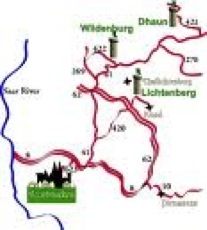
road map to Saarbrucken