my blog
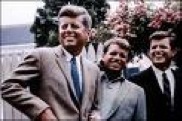
The Furry Freak Brothers were a sixties alternative comic strip. One of them showed a slouching figure with the legend "Keep on keeping on." It became a button and a bumper sticker. It is a good description of Ted Kennedy's life, personally and politically; he kept on keeping on. Big gestures, big laugh, big speeches: whatever happened, Ted Kennedy was there, working for liberal values in a party that seemed increasingly to take its liberal constituents for granted as the political center moved to the right. He kept the faith and became my favorite Kennedy of all of them.
I was eighteen in 1960 and cast my first vote for a presidential candidate - John Kennedy. It was a grudging vote; Adlai Stevenson, Democratic standard bearer in 1952 and 1956, was my King Over the Water. I voted for Humphrey in the primary as the candidate representing the liberal wing of the Democratic Party.
Jack was slick, well-packaged, had charisma, a beautiful wife. He was rich, came from a political family and wanted to be president. That was what you saw and I was afraid that was what you'd get. I wasn't sure what he would do as president and that 1960 election was the first of many votes cast grudgingly for the Democratic nominee.
The Bay of Pigs, rumours about FBI phone bugging of Martin Luther King, Jr., treatment of Stevenson and Chester Bowles, didn't improve my opinion of Jack. Then came Dallas in 1963 and whatever else Jack Kennedy could have done was cut short.
Brother Bobby was appointed assistant counsel under Joe McCarthy for his red under the bed Senate investigations. Bobby moved on and took on the Teamsters and Jimmy Hoffa in televised Senate hearings. He managed his brother's campaign and was appointed Attorney General of the United States. Bobby seemed like a rather dangerous fanatic in contrast to his much more opportunistic brother.
In 1968, I worked part time in Austin for a small union organization, a coalition of old CIO unions, The Texas State Industrial Union Council. The TSCIUC worked for labour and union rights, civil rights, and was a small but important part of the liberal/progressive alliance in Texas. I typed and I filed and I answered the phone.
One afternoon, I answered the phone and the person on the other end asked to speak to Nate Slough, my boss. "Robert Kennedy is calling."
Nate supported Robert Kennedy and, partly as a result of that phone call, came out in the monthly newsletter against the war in Viet Nam. The NMU (National Maritime Union) withdrew from the coalition as a result and since they paid a considerable amount of Nate's salary (and mine) I lost my job. I meditated as a result on the Possible In Politics.
June 6, 1968, Robert Kennedy was assassinated. I had developed liking and respect for Robert Kennedy despite McCarthy. I thought I knew what he stood for and it was about as liberal as an electable U.S. politician can get. Like Lyndon Johnson, RFK developed through his public life. LBJ, I think, was one of the great American presidents, second only to FDR in the 20th century pantheon of presidents. That's something no one would have predicted when he took office after JFK's assassination. There are politicians that grow into the job, do things no one would have predicted. LBJ was one, Ted Kennedy was another.
The Public Life versus the Private Life:
Politically, Ted consistently supported legislation to provide health care to the poor, opposed racist immigration policies, supported gun control, opposed cuts in student financial aid. He was one of only five senators to support same sex marriage, had a strong, consistent pro-environment record. While he supported the invasion of Afghanistan. He was a critic of the invasion of Iraq and voted against giving Bush the right to use force against Iraq.
He understood the way the Senate works and served as a mentor to younger senators - including Obama, whom he supported for the presidency. He was willing to work with Republicans as well as Democrats. He supported Bush's No Child Left Behind Act and helped get it through the Senate. Earlier, he'd worked with Dan Quayle to draft a bill giving training to the unemployed.
He achieved power in the Senate by hard work and intelligent use of the rules and customs of the Senate. Politically, he spent his career working for those without power. He was effective. The laws of the United States are more fair and compassionate as a result of Kennedy's legislative work.
In 1980, he gave one of the best speeches I've ever heard at the Democratic Convention. He was a better speaker than either of his brothers - and a totally different kind of orator. Passion, humour, a touch of the demagogue, maybe, but he was our demagogue and we learned we loved him at that convention.
Ted Kennedy was easy to attack; his personal life offered a lot of ammunition to his political opponents. I read comments on the obituary published in the N.Y. Times and the Austin American Statesman. Those in the Times were, in general, laudatory. Those in the Statesman yesterday, when I read it, condemned Ted Kennedy with some variant of hell fire frequently mentioned. Ted Kennedy lived 77 years and his life was summed up by these people by Chappaquiddick.
Is it fair, or even accurate, to sum up a life by the single most discreditable event in the life?
Larry King on CNN interviewed political allies and opponents of Ted Kennedy this morning. Dan Quayle said newcomers to the Senate expected the caricature portrayed by the media and found an intelligent, well-informed, warm hearted, kind, very likable guy. "You had to like him," Quayle said. "Even if you disagreed with him."
Quayle said he got a note from Ted when he started his campaign as a vice-presidential candidate. Quayle paraphrased: I wish you luck in the campaign. You won't get my vote, but I'll say nice things about you or attack you, which ever you think is more helpful.
Quayle said when he first entered the Senate Ted took him aside and told him to be sure and make time for his children, who were young. "He's the only Senator I know that remembers the names of everyone's kids," Quayle said.
All of the people King interviewed, and most of the newspaper articles, at some point use the word "likable". This is not an adjective that springs to mind when thinking of his older brothers. The Kennedys were 'patrician'. Ted wasn't; he came across as a genial Irish politician, as comfortable with the pig in the parlour as the lace curtain Boston Irish.
His brothers were Camelot. Ted was not.
Ted Kennedy did not deal in fairy tales. I always felt like he had a firm, internal moral objective as a politician. There were a number of votes in the Senate in the eighties and nineties that ended 90 something to 4, with Kennedy leading the minority view. Ted Kennedy first proposed a US Health Care Bill forty years ago. He worked to get improved access to the US medical system ever since. He consistently, day in day out, worked for a better deal for the poor and disadvantaged. His work for small incremental changes to legislation, his sponsoring major bills, made a difference to those without power. He’d compromise, to get some of what he wanted. But I never heard of any compromise to gain personal power.
One of the people Channel 4 news interviewed about the death of Ted Kennedy said, "Most people grow up and enter politics. The Kennedy men reversed the process." Both personally and politically, Ted Kennedy seemed to grow into himself, to become better than he was. Ted Kennedy,more than most public figure, shadowboxed his demons in a public arena; I'm not sure he could claim a knock out but he won on points - personally, as a human being, and publicly, as the Senator from Massachusetts.
In the oration Ted Kennedy delivered at his brother Robert's funeral, he said Robert was a good and decent man. I think the same could be said of Ted. It's not necessary to sentimentalize him: he was one of the Democratic Party Big Beasts, the last of his generation, and his influence on the country will endure. He ended up having a greater impact on the country than either of his brothers.
Ted, some of us dismissed you too early but we learned to love you before it was too late.

Friday, 28 August 2009
Ted Kennedy: RIP