my blog
"Copenhagen and Beyond" - it's rather tempting to write "Beyond"? Not much. But that's not true. "Not much good" is more accurate. Current economic and political realities prevented any legally binding commitments on the part of the wealthier, industrialized nations. It was an unfortunate juxtaposition of dire circumstances: recession, almost depression, with high unemployment and shrinking economies in the North; charity begins at home. Help the unemployed here before giving money to corrupt governments abroad.
Countries in the process of industrialization (China, India, Brazil, for example) insist that preventing them from industrialization and gaining the standard of living achieved in Europe and North America was unfair. Why should their people be locked into current development so the people of the US and Western Europe can continue living as they are?
The representatives from the South Pacific, Africa and Southeast Asia point out that global warming already affects them. For them, industrialization is not the issue: it is losing their islands, long term drought and massive flooding.
Transferring money from the North to the South would share the pain and allow adaptation to projected effects of global warming. Political leaders dodged the issue by postponing any legally binding agreement. They'll work on it and do something in a year.
A couple of years ago, a friend from one of the island nations in the South Pacific stopped by on his way back from a conference on bio-diversity in Rome. There was a session on global warming. The scientific attitude was pretty much despair. No elected official in the Western democracies could do what was needed and be re-elected. Therefore, nothing would be done.
That explains the results in Copenhagen as well as anything else I've read.
I am not convinced that ordinary people will always choose short term advantage over long term interest. l'm even hopeful that they will sacrifice their comfort for a stranger's survival. People have to be given information in order to make an informed choice. The scientific evidence is very clear - it's a matter of physics, not economics or politics. You learned the basics in elementary school.
Remember the Greenhouse effect? Carbon dioxide (CO2) and certain other gases are always present in the atmosphere. The sun emits energy that enters the earth's atmosphere. Most of this is absorbed by the oceans and land. Heat from the warmed surface of the earth radiates outward and some of the energy is absorbed by the gases in the atmosphere, which then re-emit energy - some going back back to the earth's surface. This further warms the earth.
In grade six, we learned that this was good. It prevented drastic surface fluctuations in temperature, such as those on the moon. It made life as we know it on earth possible.
Then, in Introductory Historical Geology, I learned that there were long cycles to the earth's climate: gradual heating up, gradual cooling. climate change as a result. Good, straightforward stuff - to be denied only by lunatics that believe the earth was created, complete with fossils, 10,000 years ago.
The contribution of human activity to global warming: that's really equally straightforward.
By burning coal, oil and natural gas, human beings add CO2 to the atmosphere. Clearing and burning forests for agricultural land converts organic carbon to carbon dioxide, CO2. While oceans and land plants absorb a portion of the CO2, the rest is added to the atmosphere; the natural, historical process of global warming is greatly accelerated.
Scientists predict the consequences of global warming using computer models. They differ slightly in the outcomes - partly because they make different assumptions about some of the variables, like cloud cover and ocean currents. But they are in general agreement: severe weather, raising ocean levels, melting ice caps - both of continental high mountain ranges (like the High Sierra and Himalayas) and increased drought and desertification in some of today's current agricultural areas, such as the Napa Valley. Sources of rivers, like the Colorado, will be affected and areas now irrigated will compete with urban populations for water. Both plant and animal diseases will extend their ranges, with subsequent epidemics. Human beings can adapt. Unfortunately, the parts of the world most responsible for CO2 emissions will have the resources to adapt. Those least responsible will not.
There will be winners as well as losers. The South Western US, including California, will become a desert. Sections of the coastal regions of the South Eastern US be lost. (Louisiana will be hard hit.) I'll miss New Orleans. Florida? If you have to lose a state, Texas would be my first choice; Florida second. In general, the Eastern Seaboard will take a regular battering. The islands of the Caribbean will do very badly. So will the islands of the South Pacific. Japan and the rest of South East Asia will have to invest a lot of money in defending their coast lines. Some can afford it. Some can't.
The winners: parts of the Midwestern US will have longer frost free days and thus increase the range of possible crops. The Sahara, by some models, will shrink and enough rainfall will reliably make agriculture possible.
A lot of what will happen is simply not predictable. The UK could have a more continental climate. Changes in ocean currents could result in harsher winters, warmer summers, less rain overall. Or we could more closely resemble Greenland. It depends on ocean currents and there's not enough information to predict.
Rich countries will have less to adapt to and the resources to adapt. Poor countries will be more harshly hit and have fewer resources to cope.
From all I've heard and read, China came prepared to make a deal. They expected financial resources to make the transition. Both China and India were exploited by Europe and those resources were used to industrialize the West. Raw goods exported at low prices, finished highly priced imported by the colonies. We've had a world economic system for some time and it's based on wealth streaming to the colonizing powers. At Copenhagen, there was a kind of refrain: let's not play the blame game. But we are not starting at Year Zero. The exploited have long memories. The exploiters are hurt; but that's history. We haven't done anything recently.
But China came prepared to deal. They are a major source of increasing pollution and the deal would hurt their economic efforts. They are not a democracy and thus could look at their own long term interests as well as short term ones.
There's a good chance Obama could not get any deal through Congress. There's also a good chance he could not be re-elected if he did almost anything to lessen carbon emissions. He dodged the issue by insulting China and putting things off for a year.
So we're left with an interesting situation. I respect Obama - his intelligence and his commitment to human rights and civil rights. He respects people and works for consensus. On the other side, China is an oligarchy, with very little respect for civil or human rights. The vices of one allow long term protection of human beings in general. The virtues of the other don't.
I wonder how many of Obama's Congressional opponents actually believe what they are saying. Some probably do. McCain doesn't. McCain is not a fool and he's reasonably well educated. Those who come from coal or oil producing states, Democrat or Republican, probably would lose the next election if they interfered with the profits (or jobs) in those states. The lobbying efforts, the huge sums spent, by the energy industries influences some. And some, and their supporters, probably assume that Gated Communities and wealth will isolate them and their families from social disruption. I'm all right, Jack and to hell with the rest. (California is a good example of this syndrome.)
In the EU, there are few climate change deniers. There are a number of heads of government that are are probably relieved not to have to announce to the electorate that they'd be sending money to China. (The West really resents China’s wealth.) So they all went home having decided nothing, putting off action in hope that something will turn up.
Nothing is going to turn up.
I googled 'global warming' to check some things for this. In the first half dozen sites, four were by climate change deniers. It's a little like Fox News. Freedom of Speech is Good. But what if you continually claim that Obama was born in Kenya and thus has no right to be president? There are health warnings on packets of cigarettes. At the very least, the service providers (and Fox News) should put up a warning label: evidence does not support the arguments made on this site. (Wikipedia does something similar.)
Obama is apparently trying education: a site that discusses global warming, talking heads, etc. It might work.
I read a book recently that talked about myths and humans. One of the great liberal, left of centre, myths is that people are inherently decent. Education, security, will result in a population that is generous and altruistic. The book said this wasn't true. There's no evidence that people are basically decent and a lot of history to suggest otherwise.
We live by myths. I'll keep mine: education will have an effect. If I'm wrong, and the voters of Europe and North American decide that living a life full of consumer goods is more important than food and shelter and survival for the poor (in their own countries as well as abroad) then we probably ought to suffer the the worst case scenarios that scientific models propose.

Monday, 21 December 2009
Copenhagen and Beyond
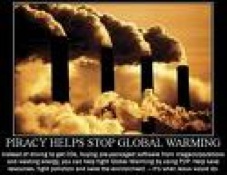
good site - suggestions for cutting personal CO2 contributions. He says the image to the left is, he thinks, a joke - but ought to work. I agree it’s funny.